
- How India’s newest aviation landmark draws on timeless cultural symbolism to shape a modern global gateway.
GUJARAT, AHMEDABAD | 12th SEPTEMBER 2025: When Navi Mumbai International Airport (NMIA) is inaugurated at the end of September, it will not just welcome passengers into one of the world’s most technologically advanced aviation hubs, it will also reveal an architectural story deeply Indian yet strikingly global. At its heart lies a motif that has shaped India’s cultural imagination for thousands of years: the lotus.
Conceived by Zaha Hadid Architects (ZHA)—the London-based studio founded by the late Pritzker Prize–winning ‘Queen of the Curve’— globally renowned for its futuristic, fluid designs that blend bold structural innovation with cultural storytelling, the airport’s design is inspired by the lotus flower, a symbol that has transcended faiths and artistic traditions. From ancient Vedic hymns and temple carvings to Mughal patterns and modern emblems, the lotus has long represented purity, resilience and transcendence. By drawing on this timeless symbol, NMIA does more than create a visual identity; it embeds cultural meaning into the very structure of a 21st-century aviation hub.
The Symbolism of the Lotus
In Indian civilisation, the lotus carries multiple layers of meaning. In Hinduism, it is linked to Lakshmi and Brahma, embodying prosperity, creation and wisdom. In Buddhism, it represents the path to enlightenment. Jainism, too, reveres the lotus as a mark of purity. Beyond religion, it has been a central motif in Indian art, appearing in domes, mandapas and palace façades. Rising unsullied from muddy waters, the lotus captures the spirit of endurance—an idea that resonates with India’s modern growth story.
For NMIA, the lotus serves both as form and metaphor. Just as the flower blooms effortlessly above the surface, the airport rises after years of land consolidation, engineering challenges and planning complexities, to emerge as a symbol of resilience and renewal for Mumbai and India.
Architecture as Identity
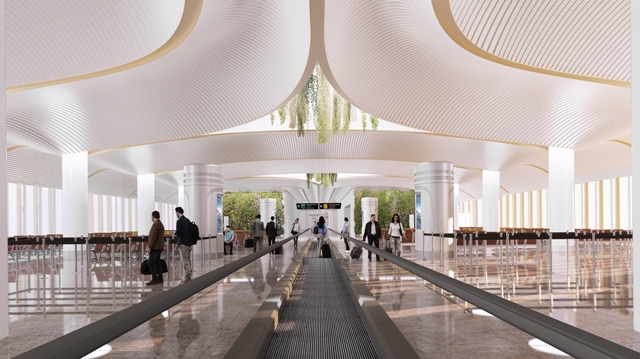
The design of NMIA translates this motif into an architectural language. The terminal roof, with its flowing contours, suggests petals unfolding in space. The central atrium resembles a lotus pond, while the radial arrangement of concourses evokes petals spreading outward. Glass façades and latticework draw inspiration from lotus leaves and jaali (lattice or perforated screens) patterns, allowing natural light to filter through while providing shade and ventilation.
Inside, the interiors carry the motif in subtle ways—on flooring, ceilings and even wayfinding signage—so that the symbolism is never ornamental excess but an embedded rhythm. The idea is to create a calming, intuitive environment for travellers, balancing grandeur with human-scale comfort.
Where Tradition Meets Modernity
ZHA’s vision for NMIA was recreated by the Navi Mumbai International Airport (Pvt.) Ltd. (NMIAL) team, not as a generic hub, but as a ’sense-of-place airport’. It has been conceived as a global gateway that reflects the spirit of its land. Around the world, leading airports have embraced this approach: Beijing’s Daxing evokes a phoenix, Denver’s roofline mirrors the Rocky Mountains of the USA, and Changi is immersed in the city-state Singapore’s tropical gardens. For Mumbai, the lotus is the perfect emblem. It is distinctively Indian, yet universal in its appeal.
The design is also deeply practical. The lotus-inspired roof form supports passive cooling, maximises daylight and integrates renewable energy and water recycling features. At full build-out, the airport will handle 90 million passengers annually, yet the design ensures intuitive passenger flows, minimises congestion and fosters a sense of serenity.
This duality—cultural symbolism paired with functionality—is what makes NMIA more than just infrastructure. It is a landmark that redefines how India presents itself to the world.
A Landmark for Mumbai
For decades, Mumbai has depended on Chhatrapati Shivaji Maharaj International Airport (CSMIA), one of the busiest single-runway airports globally, as its lifeline to world. Its Terminal 2 dazzles with a peacock-inspired design. NMIA complements this legacy with the lotus, creating a dialogue between the city’s twin gateways. Together, the peacock and the lotus express two facets of Indian identity: vibrancy and grace.
As aviation increasingly values storytelling in architecture, NMIA sets a benchmark. In an age where airports double as destinations, the design philosophy ensures that travellers don’t just pass through—they experience a narrative. The lotus, with its profound cultural resonance, positions NMIA as both a modern aviation marvel and a living artwork.
A Flower in Flight
To be sure, the lotus is not merely a visual motif for NMIA. It is the guiding principle of its architecture, giving form to a national identity that is ancient yet future-facing. Passengers walking through its terminals will step into a story that has inspired sages and artists for millennia, now reimagined in steel, glass and light.
As India accelerates into its role as a global growth engine, NMIA rises as a lotus in bloom—rooted in heritage, yet reaching skyward as a beacon of confidence, resilience and aspiration.
Infographics
Title: Lotus in Indian Civilisation
- Hinduism: Lakshmi seated on lotus – prosperity & purity
- Buddhism: Eightfold path symbolised by lotus petals
- Jainism: Lotus refers to purity of soul
- National Symbol: India’s national flower, featured on coins, textiles, and architecture
Title: Design Highlights of NMIA
- Architect: Zaha Hadid Architects, the UK
- Motif: Lotus petals in roof and concourse layout
- Interiors: Subtle lotus patterns on flooring, ceilings and signage
- Façade: Glass &jaali inspired by lotus leaves
- Atrium: Central space designed as a lotus pond metaphor
Title: Global Airports with Cultural Motifs
- Beijing Daxing (China): Phoenix-inspired roof design
- Denver International (USA): Peaks evoking Rocky Mountains
- Changi (Singapore): Nature and gardens as central theme
- Hamad International (Qatar): Desert waves & marine forms
NMIA (India): Lotus – purity, resilience, transcendence
