
Report recommends structured authorisation of non-transport motorcycles, platform-led accountability, harmonised safety standards and incentive-based EV transition
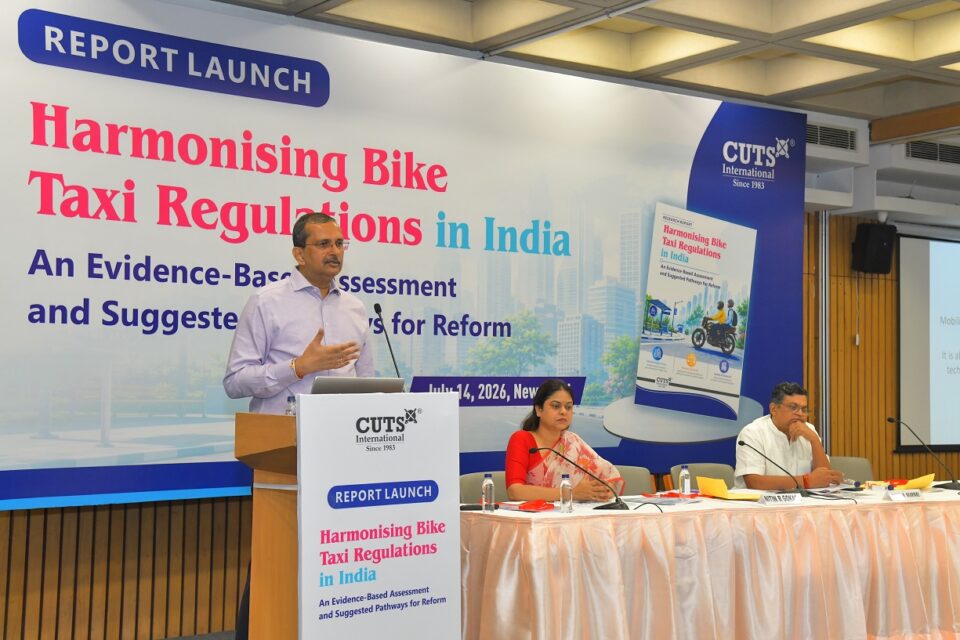
NEW DELHI | 14th JULY 2026 | India needs a harmonised, evidence-based and proportionate regulatory framework for bike taxis to address fragmented state-level implementation, protect gig worker livelihoods, improve first- and last-mile connectivity, and ensure commuter safety, according to a new report by CUTS International.
The report, “Harmonising Bike Taxi Regulations in India: An Evidence-Based Assessment and Suggested Pathways for Reform,” was launched today in New Delhi by Gopal Krishna Agarwal, National Spokesperson, Economic Affairs, Bharatiya Janata Party.
Speaking at the launch, Agarwal said, “As India strengthens its ease of living agenda, an integrated mobility ecosystem can become a vital driver of connectivity, employment, productivity, and sustainable growth.”
The report comes at a time when bike taxi regulation in India is undergoing rapid change, with states adopting divergent approaches ranging from enabling frameworks and conditional permissions to restrictions, EV-only mandates and legal uncertainty. CUTS notes that this fragmented landscape has created uncertainty for commuters, gig workers, platform aggregators and regulators, making the case for a predictable and coherent policy framework.
Key findings of the CUTS report
- Bike taxis have emerged as a structurally important part of India’s urban mobility ecosystem.
The report notes that bike taxis help address first- and last-mile connectivity gaps, complement public transport systems, and improve access to metro and bus networks, especially for short-distance travel. - The legal foundation for bike taxis already exists.
The report states that motorcycles used for hire have a legal basis under the Motor Vehicles Act, 1988, and are guided by the Motor Vehicle Aggregator Guidelines, 2025, issued by the Ministry of Road Transport and Highways. The challenge lies in consistent and coherent state-level implementation. - State-level regulatory divergence is creating uncertainty.
The report studies approaches across Delhi, Kerala, Maharashtra, Rajasthan, Tamil Nadu and West Bengal, and finds that identical services are permitted in some jurisdictions and restricted in others. This increases compliance burdens, limits workforce mobility, pushes disputes towards judicial intervention and weakens long-term policy predictability. - Bike taxis offer a strong affordability advantage for commuters.
The report finds that bike taxis typically cost ₹8–10 per kilometre, compared to ₹15–18 per kilometre for auto-rickshaws and ₹22–25 per kilometre for regular taxis. This makes them especially relevant for students, informal workers, young professionals and peri-urban commuters. - Bike taxis create low-barrier livelihood opportunities.
The report notes that two-wheelers allow youth, migrants and informal workers to access flexible livelihood opportunities with relatively low upfront investment. Citing industry estimates, it states that bike taxi operators can earn average monthly net incomes of ₹25,000–30,000 after accounting for operating expenses. - Restrictions can disrupt livelihoods without resolving safety or congestion concerns.
CUTS finds that enforcement-led or prohibition-based approaches have disrupted livelihoods without demonstrably improving congestion or safety outcomes. The report argues that safety concerns are better addressed through formal regulation rather than blanket restrictions. - Mandatory commercial conversion can be financially burdensome for workers.
The report notes that permanent conversion of private motorcycles into transport vehicles can impose disproportionate financial and procedural burdens, including re-registration costs, higher insurance premiums and fitness certification requirements. This can be especially difficult for part-time or intermittent workers who use bike taxis as supplementary income. - Safety and welfare standards need to be harmonised across states.
CUTS recommends baseline safety and welfare standards, including mandatory health and accident insurance for drivers and passengers, helmet enforcement, transparent fare-setting frameworks, accessible grievance redressal mechanisms and clear revenue-sharing norms. - EV transition should be incentive-led, not exclusionary.
The report supports electrification but recommends phased timelines and incentive-based policies rather than immediate exclusion of internal combustion engine vehicles. It notes that EV mandates without adequate charging infrastructure or transitional support can create entry barriers and limit participation by gig workers. - States can use bike taxi regulation as a revenue and formalisation opportunity.
CUTS suggests period-specific permit frameworks, structured permit fees or trip-linked levies to help states regulate market scale while creating predictable revenue streams and avoiding high upfront costs for individual drivers.
Key recommendations
Based on its findings, the CUTS report recommends that states consider:
- Moving away from blanket prohibitions and enforcement-led approaches towards structured authorisation of bike taxi operations.
- Operationalising the 2025 Motor Vehicle Aggregator Guidelines through notified state schemes.
- Allowing aggregation of non-transport motorcycles subject to defined safety, insurance and compliance conditions.
- Adopting a platform-authorised usage model instead of mandating permanent commercial conversion of private motorcycles.
- Creating period-specific permit frameworks to regulate scale and prevent excessive market saturation.
- Harmonising baseline safety and welfare standards across states.
- Promoting EV adoption through incentives, phased timelines and infrastructure support.
- Using lightweight permit and compliance models to support formalisation while protecting driver livelihoods.
Delivering the special address at the launch, Nitin R. Gokarn, Chairman, National Road Safety Board, observed that innovation often moves faster than regulation, and that regulatory frameworks must evolve in a timely manner to support safe and accountable growth in emerging mobility sectors.
The launch also featured two panel discussions on regulatory harmonisation, legal ambiguity, mobility innovation, livelihoods and consumer welfare.
The first panel, “Harmonising Regulation Across States: Bridging Policy Gaps and Legal Ambiguities,” was moderated by Amol Kulkarni, Director, Research, CUTS International. The panel included Chhavi Banswal, Founder and Principal Consultant, Chiral Consulting; Paroma Bhat, Head of Public Policy and Government Relations, Uber India and South Asia; Pravesh Biyani, Centre of Excellence on Sustainable Mobility, IIIT Delhi; Shantanu Sharma, Senior Manager, Law, Policy and Regulations, Rapido; and Nikhil Rathi, Senior Account Director, Public Policy, Chase Advisors.
The second panel, “Bike Taxis in India’s Mobility Ecosystem: Innovation, Livelihoods and Consumer Welfare,” was moderated by Anil Sasi, National Business Editor, The Indian Express. The panel featured Virendra S. Rathore, Deputy Commissioner, Department of Transport, Government of Rajasthan; Shiksha Srivastava, Associate, PLR Chambers; Shreya Yadav, Associate Manager, Legal Public Policy and Corporate Affairs, Rapido; and Sourav Dhar, Programme Lead, Mobility, Council on Energy, Environment and Water.
The discussions reinforced the need for a harmonised, evidence-based framework that balances commuter safety, worker welfare, innovation, consumer choice and regulatory certainty. Speakers also emphasised that bike taxis should be viewed as part of India’s broader urban mobility ecosystem, particularly where they support affordable short-distance travel, first- and last-mile connectivity and flexible livelihood creation.
CUTS International reaffirmed its commitment to supporting evidence-based policymaking and facilitating continued engagement among governments, industry, academia and civil society to advance transparent, predictable and inclusive regulation.
The report is available at: https://cuts-ccier.org/pdf/research-report-harmonising-bike-taxi-regulations-in-india-an-evidence-based-assessment-and-suggested-pathways-for-reform.pdf
== ENDS ==
